

Understanding the Basics of Charging Types
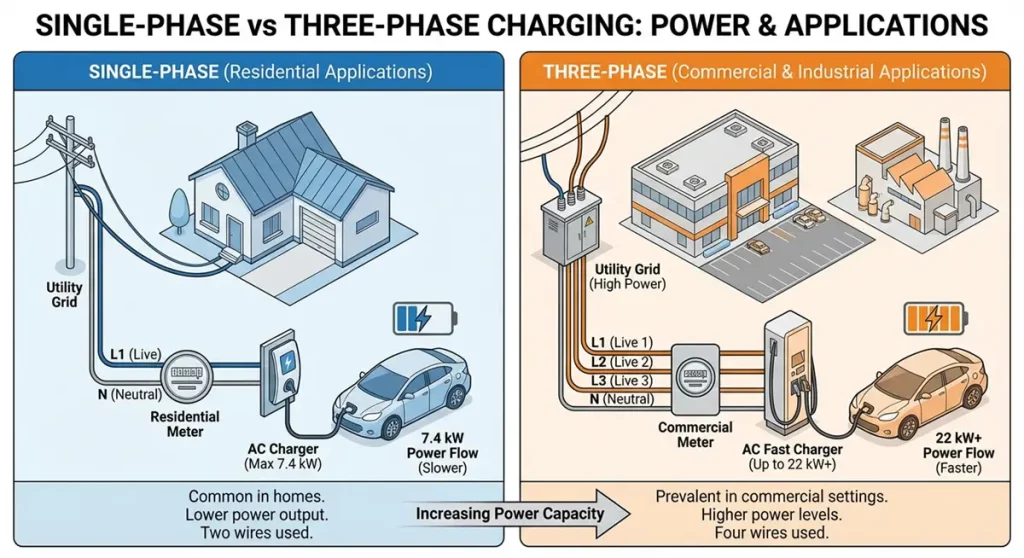
When charging electric vehicles (EVs), it is important to distinguish between single-phase and three-phase electrical connections. Single-phase charging supplies the vehicle through one electrical line, while three-phase charging uses three lines simultaneously.
Single-phase connections are common in private homes because they are compatible with standard household electrical systems, such as 230 V and 16 A sockets. They typically provide charging power between 3.7 kW and 7.4 kW, depending on the circuit protection and the charger used.
Three-phase charging, on the other hand, uses 380–400 V across three phases, enabling significantly higher charging power. In practice, this is usually 11 kW to 22 kW for homes and AC charging stations, and even more for commercial users. This allows vehicles to be charged more quickly, which is particularly useful for drivers with higher energy needs or limited charging time.

Charging Speed and Everyday Practicality
Charging time depends heavily on the type of electrical supply. Single-phase charging is sufficient for daily commuting, especially when the battery capacity is moderate, such as 40–60 kWh. With 7.4 kW charging power, a 50 kWh battery can typically be fully charged in around 6–7 hours.
Three-phase charging reduces this time considerably. At 11 kW, charging can take around 4–5 hours, while a 22 kW solution may reduce it to only 2–3 hours. For commuters or families with several EVs, this can make the difference between convenient overnight charging and the need for additional charging during the day.
Important: Not every vehicle can charge using three phases. Before purchasing a charger, check whether the onboard charger supports the desired charging power.
Costs and Installation Requirements
Installing a single-phase wallbox is generally straightforward and cost-effective, as it can often be connected to an existing household electrical circuit. Three-phase wallboxes, however, frequently require stronger circuit protection and professional electrical installation. This can increase installation costs, but it offers long-term benefits through faster charging times.
For example, a 7.4 kW single-phase wallbox including installation may cost approximately €1,000–€1,500. A three-phase 11–22 kW solution may cost around €2,000–€3,500. For drivers who need more range or charge several vehicles, the higher initial investment can often pay off quickly.
Home Use vs. Commercial Use
For private households with one vehicle and overnight charging, a single-phase solution is often sufficient. Its flexible installation options and lower cost make it an attractive choice.
In commercial environments or for vehicle fleets, a three-phase connection is often the better option. Shorter charging times are essential for maximising vehicle availability. In addition, higher-power charging stations can serve several vehicles at the same time without compromising grid stability.
Compatibility and Infrastructure
Compatibility is another important consideration. Many public AC charging stations in Europe are designed for three-phase charging, particularly 11 kW and 22 kW stations. Single-phase chargers can also work at these stations, but they cannot use the full available charging power.
Single-phase charging remains limited to standard household sockets and is best suited for entry-level or temporary charging solutions, such as at holiday homes or small garages where an expensive three-phase installation would not be cost-effective.

Summary and Decision Guide
- Single-phase charging: Cost-effective, easy to install, and ideal for smaller batteries and overnight commuting. Charging power: 3.7–7.4 kW.
-
Three-phase charging: Higher charging power and faster charging times; suitable for larger batteries, multiple vehicles, or commercial use. Charging power: 11–22 kW.
Practical tip: Check your vehicle’s maximum AC charging power, your existing electrical protection, and your daily energy needs. This will help you choose a tailored charging solution that balances both cost and charging speed.
A well-planned installation improves charging efficiency, supports battery longevity, and saves energy and time in the long term.
Weitere Lektüre: CCS2 einfach erklärt: Europas Standard für Schnellladen


Share:
AC vs. DC Laden bei Elektroautos: Unterschiede einfach erklärt
Alles über europäische Steckertypen und ihre Verwendung