

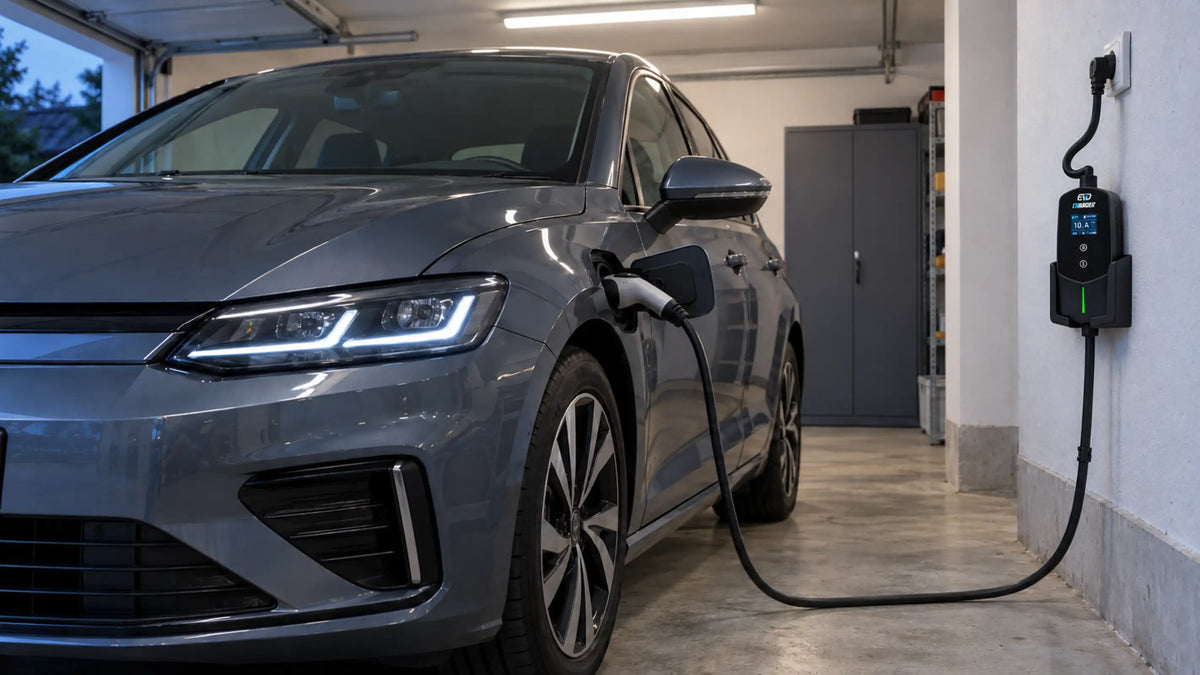
Adjustable charging current lets a portable EV charger use different power levels. A higher setting can shorten charging time, while a lower setting reduces the demand placed on the electrical supply. The selected current must always be suitable for the socket and circuit.

The Current Setting Sets a Maximum
Charging current is measured in amperes and displayed as A. A portable charger may offer several settings, such as 6 A, 8 A, 10 A, 13 A and 16 A.
The selected value is the maximum current that the charger makes available to the vehicle. It does not mean the vehicle will always use the full amount.
The vehicle may draw less current because of its onboard charger, battery condition or charging settings.
Higher Current Provides More Charging Power
On a single-phase 230 V connection, the approximate charging power can be calculated by multiplying the voltage by the current.
| Current setting | Approximate power at 230 V |
|---|---|
| 6 A | 1.38 kW |
| 8 A | 1.84 kW |
| 10 A | 2.30 kW |
| 13 A | 2.99 kW |
| 16 A | 3.68 kW |
The basic calculation is:
Voltage × Current ÷ 1,000 = Power in kW
A higher current normally allows the vehicle to receive more energy in the same amount of time. Selecting a lower current usually means that charging will take longer.
For a driver who charges overnight at home and occasionally uses another suitable location, an adjustable Schuko portable EV charger provides 6 A, 8 A, 10 A, 13 A and 16 A settings. Its maximum rated output is 3.68 kW at 230 V.
A Lower Setting Can Suit Slower Charging
A lower current can be useful when the confirmed limit of the charging location is below the charger’s maximum setting. It can also reduce the charger’s share of the available power when other equipment uses the same suitable circuit.
Not every vehicle needs to charge as quickly as possible. If the car remains parked overnight, a lower setting may still add enough energy before the next journey.
The charging location must still be checked before use. Selecting 6 A or 8 A does not automatically make an unknown socket suitable for EV charging.
Not Every Schuko Socket Is Suitable for 16 A Charging
A portable charger rated at 16 A is capable of using that current under the correct conditions. This does not confirm that every Schuko socket and household circuit can support extended EV charging at 16 A.
Use the 16 A setting only when the socket and circuit are confirmed to be suitable. If the condition or capacity of the electrical supply is unknown, it should be checked before charging.
Stop using the connection if the plug or socket is loose, damaged, discoloured or unusually hot. Lowering the charging current is not a solution for a connection that already shows signs of damage.
Adjustable Current Does Not Change the Electrical Supply
Reducing the current does not repair an old or damaged socket. It also does not increase the amount of power that the household wiring can provide.
The setting cannot make a vehicle charge above its own AC limit either. If the vehicle accepts less current than the charger offers, it will charge at the lower supported level.
Adjustable current provides flexibility between suitable charging locations, but it does not replace checking the socket, plug and cable before use.

The Charging Location Determines the Right Setting
The highest available setting is not automatically the right choice. Use a current level that the confirmed socket and circuit can support and that provides enough energy for the next journey.
A higher setting can reduce charging time. A lower setting reduces power demand. The best choice depends on the available electrical connection and how long the vehicle can remain plugged in.
Recommend Reading: Schuko or CEE: Which EV Charger Is the Better Fit?


Share:
VW ID. Polo Elektroauto 2026: Daten, Preis und Reichweite