

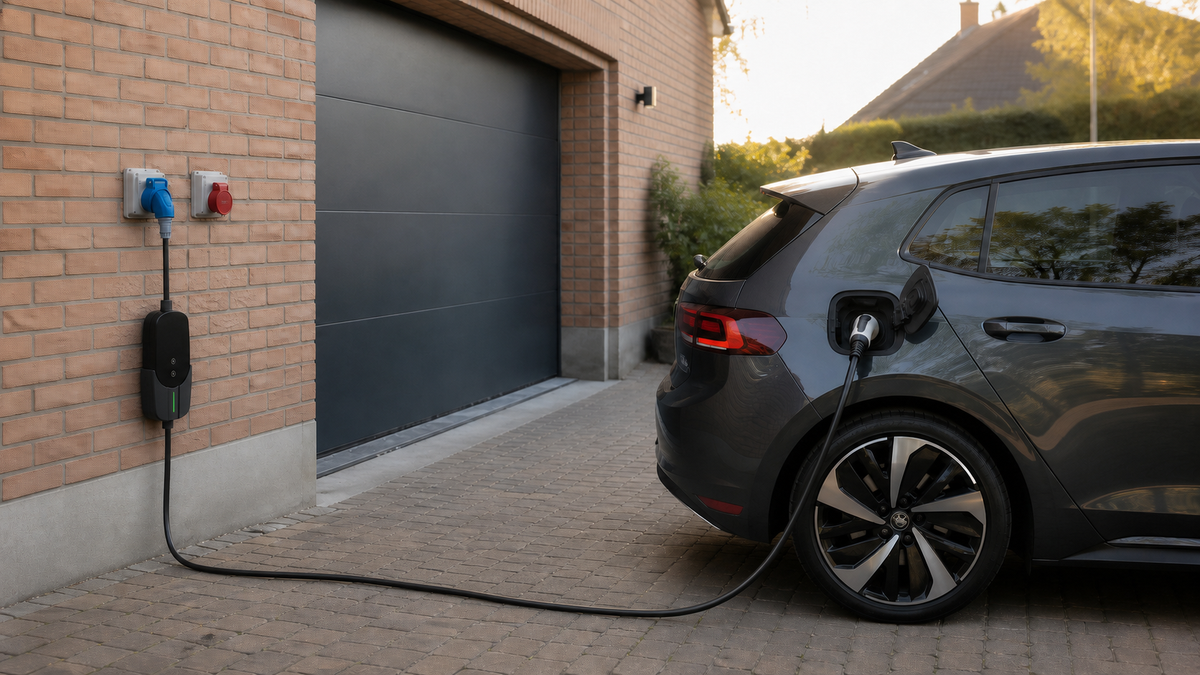
16A vs 32A CEE EV Charger: Which One Do You Need?

A 32A CEE EV charger is not automatically better than a 16A charger. The right choice depends on the CEE socket you already have, whether your supply is single-phase or three-phase, and the maximum AC charging power supported by your EV.
In the UK, CEE sockets are often called Commando sockets. They are commonly found in garages, workshops, campsites and commercial locations.
As a quick guide:
-
16A single-phase: up to around 3.7 kW
-
32A single-phase: up to around 7.4 kW
-
16A three-phase: up to around 11 kW
-
32A three-phase: up to around 22 kW
The actual charging speed is always limited by the lowest-rated part of the system, including the vehicle, charger, socket and electrical installation.
16A vs 32A CEE EV Charger: Quick Comparison
| Supply Type | 16A CEE | 32A CEE |
|---|---|---|
| Single-phase | Up to around 3.7 kW | Up to around 7.4 kW |
| Three-phase | Up to around 11 kW | Up to around 22 kW |
| Best for | Regular overnight charging | Higher-power AC charging |
| Electrical load | Lower | Higher |
Important: A 32A charger will not make every EV charge at 22 kW. The car itself must support that AC charging power.
First, Check the CEE Socket You Have
Before choosing a charger, check the socket and electrical supply available at your location.
You need to confirm:
-
whether the socket is 16A or 32A
-
whether the supply is single-phase or three-phase
-
the voltage of the socket
-
whether the electrical circuit is suitable for continuous EV charging
Do not choose a charger only because it has a higher amp rating.
What Charging Power Can You Expect?
The current rating and number of phases both affect charging power.
16A single-phase
Up to around 3.7 kW
Suitable for overnight charging, plug-in hybrids and drivers with moderate daily mileage.
32A single-phase
Up to around 7.4 kW
Can charge faster than 16A single-phase if the vehicle supports the available AC power.
16A three-phase
Up to around 11 kW
A common and practical charging level for many European EVs.
If you already have a compatible three-phase 16A CEE socket, the EVDANCE 11 kW 16A CEE Mobile Wallbox is designed for this type of setup.
32A three-phase
Up to around 22 kW
Useful only when both the electrical supply and vehicle support 22 kW AC charging.
When Does a 16A Charger Make Sense?
A 16A CEE EV charger may be the better option if:
-
you already have a 16A CEE socket
-
you normally charge overnight
-
your EV supports up to around 11 kW AC charging
-
your daily driving distance is moderate
-
you want to keep the electrical load lower
For many EV owners, especially those charging overnight, 16A can already provide enough charging power.
When Does a 32A Charger Make Sense?
A 32A charger may be more suitable if:
-
you already have a compatible 32A CEE socket
-
your electrical installation supports the higher current
-
your EV supports 7.4 kW AC charging
-
you regularly need to recharge larger amounts of energy
-
faster AC charging is important to you
For a compatible single-phase 32A CEE supply, the EVDANCE 32A 7.36 kW Type 2 EV Charger is one suitable option.
However, a 32A charger is only useful if your vehicle and electrical supply can take advantage of the extra power.
Which Should You Choose?
| Choose 16A if… | Choose 32A if… |
|---|---|
| You have a 16A CEE socket | You have a 32A CEE socket |
| Overnight charging is enough | You need faster AC charging |
| Your EV supports up to around 11 kW AC | Your EV supports higher AC charging power |
| You want lower electrical load | Your installation supports higher current |
For most buyers, the correct socket and the vehicle's AC charging limit are more important than simply choosing the charger with the highest amperage.
Check Your Vehicle Before Ordering
Your EV has an onboard AC charger that determines how much AC power the vehicle can accept.
Common AC charging limits include:
-
3.7 kW
-
7.4 kW
-
11 kW
-
22 kW
For example, if your car supports a maximum of 11 kW AC, using a 22 kW charging source will not normally make it charge at 22 kW.
Always check the vehicle specification before ordering a charger.
Blue vs Red CEE / Commando Sockets

CEE sockets are commonly identified by colour.
Blue CEE sockets are often associated with 230V single-phase supplies.
Red CEE sockets are commonly used for 400V three-phase supplies.
However, colour should only be treated as a useful clue. Always check the actual current rating, voltage and phase configuration before connecting an EV charger.
Electrical Safety Matters
Portable EV charging places a significant electrical load on the circuit for a long period.
Before regular charging, make sure:
-
the CEE socket is correctly installed
-
the circuit is appropriately protected
-
the wiring is suitable for the required current
-
the socket is in good condition
-
the charger matches the socket exactly
Avoid ordinary household extension leads, multi-plug adapters and unapproved converters.
If you are unsure about the socket or electrical installation, consult a qualified electrician.
Simple Buying Checklist
Before choosing between a 16A and 32A EV charger, check:
-
Is my CEE socket 16A or 32A?
-
Is the supply single-phase or three-phase?
-
What is my vehicle's maximum AC charging power?
-
Does the charger plug match the socket?
-
Is the circuit suitable for EV charging?
-
Is the cable long enough for my parking position?
Frequently Asked Questions
Will a 32A charger always charge faster than a 16A charger?
No. The charging speed is limited by the vehicle, charger, socket and electrical supply.
Can I use a 32A charger with a 16A socket?
Only use charging equipment that is specifically compatible with the socket and circuit. Never exceed the electrical rating of the installation.
Is 11 kW enough for home EV charging?
For many drivers, yes. 11 kW is fast enough for regular overnight charging in many everyday situations.
Do I need three-phase power for 11 kW charging?
Typically yes. 11 kW AC charging generally uses a three-phase 16A supply.
Do I need three-phase power for 22 kW charging?
Typically yes. 22 kW AC charging generally requires a suitable three-phase 32A supply and a vehicle that supports 22 kW AC charging.
What is a Commando socket?
“Commando socket” is a common UK term for industrial CEE / IEC 60309-style sockets.
Final Verdict: 16A or 32A?
Choose the charger that matches your actual electrical setup and vehicle.
A 16A CEE EV charger is often enough for regular overnight charging and can provide up to around 11 kW on a compatible three-phase supply.
A 32A CEE EV charger can provide higher charging power, but only if the socket, electrical installation and vehicle all support it.
In most cases, matching the charger correctly to the socket and EV is more important than simply choosing the highest amp rating.
Find the Right CEE EV Charger

For 16A three-phase CEE charging:
EVDANCE 11 kW 16A CEE Mobile Wallbox
For 32A single-phase CEE charging:
EVDANCE 32A 7.36 kW Type 2 EV Charger


Share:
E-Auto-Ladezeit berechnen: Wie lange dauern 2,3, 3,7, 11 und 22 kW?
Portable EV Charger vs. Type 2 Cable: What Is the Difference?