

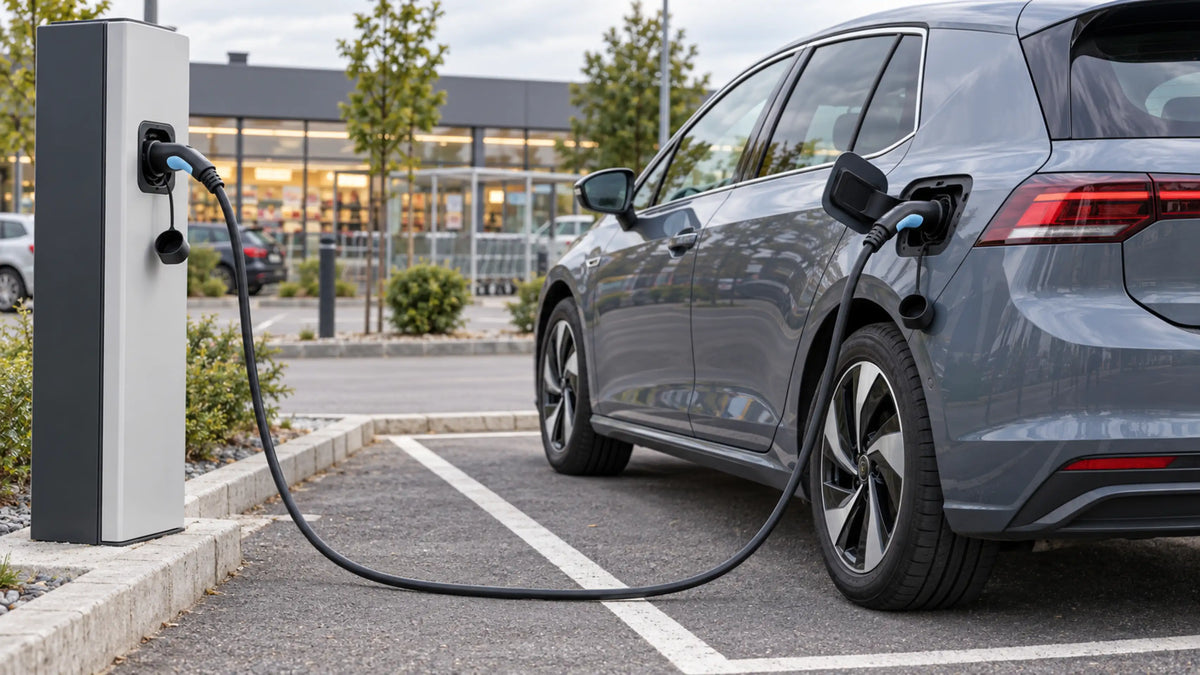
At most untethered public AC stations in Europe, an electric vehicle with a Type 2 inlet needs a Type 2-to-Type 2 Mode 3 charging cable. If the station already has a permanently attached cable, drivers normally use the cable provided.
Check Whether the Station Has a Cable
An untethered AC charging station has a socket but no attached cable. In Europe, this is normally a Type 2 socket, so the driver must bring a compatible cable.
Some AC chargers already have a fixed cable. DC fast-charging stations also normally provide an attached CCS cable. In these situations, a separate Type 2 cable is not required.
The station information in a charging App may show whether a cable is attached. The connector or socket can also be checked after arriving.
Match the Cable to the Vehicle Inlet
Most current European electric vehicles have a Type 2 AC inlet. These vehicles normally need a Type 2-to-Type 2 cable, with one connector for the station and the other for the vehicle.
Some older vehicles have a Type 1 inlet. They require a suitable Type 2-to-Type 1 Mode 3 cable when using a European Type 2 AC station.
A portable charger with a Schuko or CEE plug is a different product and cannot be connected directly to the Type 2 socket on a public charging station. See Portable EV Charger vs. Type 2 Cable for a closer explanation.
Choose the Appropriate Cable Rating
An 11 kW three-phase Type 2 cable is normally rated at 16 A per phase, while a 22 kW three-phase cable is rated at 32 A per phase.
A driver whose vehicle accepts up to 11 kW AC may choose an 11 kW Type 2 charging cable. A vehicle that supports 22 kW AC may be better matched with a 22 kW Type 2 charging cable.
The cable rating does not determine the charging speed on its own. The vehicle, charging station and cable all contribute to the available power. A 22 kW cable can be used at a compatible lower-power Type 2 station, but it does not make an 11 kW vehicle charge at 22 kW.
For a detailed comparison, see 7.4 kW, 11 kW or 22 kW: Which Type 2 Cable Do I Need?.
Type 2 charging cables are available in 6 m, 8 m and 10 m lengths. To find the most suitable option for different parking situations, see What Length Type 2 Charging Cable Do I Need?.

Other Charging Equipment Does Not Replace the Cable
A Schuko or CEE portable charger is designed for a compatible electrical socket. It does not replace a Type 2-to-Type 2 cable at an untethered public AC station.
Drivers also do not need to bring a CCS cable for public DC charging because the high-power cable is normally attached to the charger.
Ordinary household extension cables or improvised adapter combinations should not be used to connect a vehicle to a public Type 2 charging point.
The Practical Choice
For most current European EVs, the practical choice for an untethered public AC station is a correctly rated Type 2-to-Type 2 cable. Check the vehicle inlet first, then select the appropriate power rating and a convenient length.
Recommend Reading: Portable EV Charger vs. Type 2 Cable: What Is the Difference?


Share:
Wi-Fi, Bluetooth and RFID on a Wallbox Explained